Fun with Fonts: How Readable is Your Book?

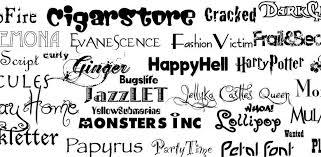
fonts3

Source: Google Images/wpstic.com

An Eye for Fonts?

I admit I know little about fonts in the technical sense. As a creative, I’ve always chosen fonts for their look and feel. It’s why I chose the font Candara for my nutrition book. It’s a serif font with delicate strokes reminiscent of an Asian font, which made sense to me since the book is about Chinese nutrition therapy.

But I did notice after publishing the book (and re-reading it for errors) that Candara, while pleasant to read, is not as crisp on the page as I would like. I thought perhaps it was the printing process, that the quality wasn’t there. Not true. I’ve had other books printed with different fonts by the same company and I didn’t ‘see’ a font issue. Looking at other documents where I’ve used Candara, I now understand it was not the best choice, leaving me to wonder how it affects a customer’s reading (and retention).

Technical Readability

Do the fonts in your books offer readability? Are the letters distinguishable from each other? Do readers’ eyes flow through the text without any visual discomfort? For me, large round letters like Arial give me an eyeball  headache when used for lengthy articles or books.

And yet I find it ironic that a good online article on fonts and readability of books is written in a pale gray Arial font on a stark white background. Talk about a hard read…
Serif, Not Sans is Best

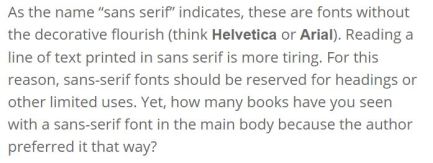
According to the article, serif fonts give a book more readability. Think of those fine strokes at the end of each letter. That’s a serif font. Serif fonts pull words together, making them easier to read (and less likely to cause eyeball headache or lost interest in what you’re reading). Sans serif fonts like Arial are more difficult to read in body text so reserve them for headings and titles (see example above).

The font you choose can also send a message to the reader; hence, my choice of Candara for an Asian-themed book. Editors will read a manuscript and decide the best font for both look and feel. Again, because it’s something I always looked at from an artistic perspective, I never considered the technical side. Just another of many lessons learned in the self-publishing process.

How To Choose?

So how do you decide which fonts to use if you’re a self-publisher? Do the research. A good place to start is The Book Designer website. (The late) Joel Friedman designed books and worked with typesetting for decades. His still active website offers much useful information and some free downloads, too. If you have a good editor, ask for font recommendations. Play with different serif fonts, see how it makes the story feel as you read it. You can even print sections in different serif fonts and have family or friends read the passages and report back on the readability.

In the Ingram Spark article, these were the top serif fonts for books: 

  1. Caslon – preferred by book designers
  2. Garamond – originated in France; a popular font for books
  3. Jenson – designed for Adobe systems
  4. Minion – designed for Adobe systems
  5. Palatino – originally intended for headings and smaller sections, it was later tweaked for use in book texts

The Sky’s the Limit… Sort Of

For chapter titles, book designers generally advise staying away from over-used  fonts like Comic Sans or Papyrus; decorative fonts like script fonts are best avoided as well. In my first fiction novel, I was feeling adventurous (especially since I was writing an adventure novel) and used an unusual font called Yanks Hand for the chapter titles. Gave the book a slightly quirky look and feel, which worked with the unique genre/story line (Native American spirits/religion).

But what do you do if you don’t have/use Adobe systems? Well, for starters you can go to the website MyFonts.com to test fonts before purchasing them. Once you find a font you like, make sure to purchase the entire family of that font (regular, bold, italic, etc.). In Adobe systems, each version of a font is unique and if you don’t purchase the whole family, you won’t legally be able to use italics, for example, if you didn’t buy it.

Remember, what’s most important is your book’s readability. Get that right from the beginning and your readers will ‘see’ your story in a better light. And font!

P.S. I’m trying new fonts on my blogs. This one is Libre Baskerville. I found the last serif too small. Might go back to the sans serif, Alegreya Sans. Do you find this new font more readable? Less?

Are You a Copycat or Trailblazer?

trailblazer1

Source: pixabay.com

Which One Are You?

The topic for this blog hit me as I perused the same ol’ same ol’ of “how to” articles/posts: how to make an infographic for your website, how to not suck at marketing, how to earn more with CPC (click to pay ads) on FB or Amazon, etc. There’s a proliferation of knowledgeable (and not-so-much-so) bloggers and authors out there in digital space eager to share what they’ve learned from their successes and mistakes.

But at what point can I/you turn away from all the “do-this-if-you-want-this-result” advice and blaze my/your own trail in the world of writing/self-publishing? Looking back over the last thirteen years (I self-published my first book in ’07), I have learned more on my own.

Considering that one of my books (published in ’16) still sells monthly, I’d say that makes me a trailblazer

In reading some of these articles/posts, it struck me that one writer’s path to success is not necessarily another’s. Just because Joe Author found a way to get a gazillion hits on his website and Jane Writer discovered the “secret” to successfully marketing her book doesn’t mean we have to follow in their paths (copycat).

Yet there is validity in much of the shared successes by authors online. It’s always been a good idea to learn from others’ experiences, both successes and mistakes. What’s vital is knowing when that information will benefit you and your writing business.

Good But Not How-to Advice

Take, for example, George R. R. Martin, famous for his Game of Thrones series/movies. Instead of providing a bunch of ‘how-to’s’ he offers up his personal approach to writing/telling stories. This personalizes the writing experience. Many writers can identify with what George experiences when he writes. This kind of ‘experiential’ advice seems more powerful, more useful, to me. And perhaps to you, as well.  These are some of my faves, as I can identify with what he’s talking about: 

“I end each chapter with a cliffhanger, resolution, a turn, a reveal, a new wrinkle … something that will make you want to read the next chapter of that character.”


“I want a story to take me to a place that I’ve never been to before and make it come vividly alive for me.”


“It doesn’t matter what the scene is. You can see it and you can hear it, but you’re still staring at a blank screen. That’s the nuts and bolts of writing.”


“I’ve never been a fast writer, and I’ve never been good with deadlines.”


“One of the big things that distinguishes the strongest fiction from writing that’s perhaps without depth is a real understanding of what real human beings are like.”

In the end, what it comes down to is doing what’s best for you and your stories. Follow someone else’s lead if it will bring you somewhere you need to go. Otherwise, blazing your own trail in the writing/publishing world, while it may prove daunting, will most certainly bring you to triumph albeit via a bumpier road. The bumps and bruises I gained along the way are mine and mine alone; better for me to trip up myself than for someone else to do it. That’s what makes me a trailblazer.

#GeorgeRRMartin #GameofThrones #howtobeabetterwriter #writing #storytelling #fictionwriting #marketingyourbooks #authorblog #mestengobooks 

Writers, What Do You Read?

books and coffee

Source: pexels.com

It’s known in the world of writing that all good writers make time to read. Some voraciously, some in between their own works or when taking a break from their writing. Do you read in the same genre as what you write? Or do you step outside of your knowledge or comfort zone to expand your mind and imagination?

Find Your Faves

Late last year I got hooked on novels by bestselling author Daniel Silva (along with David Baldacci & Carlos Ruiz Zafón). To sum it up, he’s absolutely brilliant. Doesn’t hurt that he has a background in journalism and international relations (talk about ‘write what you know’). He writes the most powerful spy/action novels; better than any Tom Clancy novel, in my opinion (and not the least bit dry as John Le Carré). Last year, I picked up a copy of The English Girl in the “New” section of the local library; ironically, I didn’t feel strongly about the protagonist or the story line. Yet something drew me back. I read a few more of his novels and now I’m hooked.

I just finished Prince of Fire and will request another of his books soon. Luckily, there are still at least a half dozen of his books to read. I also just finished the latest by Craig Johnson (famous for the former Netflix show Longmire), Land of Wolves, another can’t-put-it-down kind of book. I’m about to read (again) The Shadow of the Wind by Carlos Ruiz Zafón; you simply MUST read it, as it’s unlike any book I’ve read before (and don’t forget to read the other three books in this series!).

Gaining Perspective

Reading these books are mainly for my entertainment (and escape) but somewhere along the way I began looking at them from a writer’s perspective. Then an editor’s. And back to a writer’s. This process has melded with my love of reading and helped me to better understand how to build scenes, create dialogue, and craft suspense in a way that keeps one turning the pages (compelling). I make mental notes of words I’d like to use in my writing, including some I have to look up because either I haven’t used them in a long time or I don’t know what they mean.

Yet all this reading has not affected what I write. What I mean by that is I haven’t changed style or genre simply because I enjoy reading mostly crime novels. I enjoy a variety in my reading; the same goes for my writing. Which probably explains my affinity for both fiction and nonfiction writing, even though I do not tend toward more than the very occasional nonfiction read (I think it’s because I’m reminded of much-despised homework assignments.)

Does what you read affect what or how you write? Have you thought about the relationship between the two, if there is one? Does reading for entertainment enlighten you as a storyteller? Does writing open your reading options? As writers, we can appreciate a good book – whether we’ve written it or read it. So for the sake of  good stories, let’s keep writing and reading.

#writersreading #writersofinstagram #writersoftwitter #author #writersdigest #fiction #nonfiction