Writing with Purpose

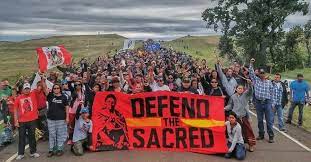
dakota pipeline

Source: Google Images

Yesterday I posted a link to a well-written article on the Dakota Pipeline project and its effect on Native peoples of that region. While it is not my intention to politicize my blog, I deemed this article, written by an intelligent and compassionate woman, an important read.

As writers, we cannot shy away from the dirty or difficult issues in our nonfiction work or occasionally in our blogs. Important issues, however difficult or delicate, must be discussed. It is, in my opinion as a writer, our duty to use our words and to string them together in a way that educates, enlivens, and fills those who read our blogs/books/articles with a sense of purpose and to motivate. I simply CANNOT ignore this subject and therefore I must write this post with a sense of purpose.

This pipeline is a major issue that will affect far more people (and animals and nature in general) than Native peoples. A friend of mine from here in NorCal left for the Dakotas with his wife several days ago. They’re bringing clothing donations directly to the people on the front lines. With everything that’s happened thus far – hosing innocent protesters with icy water in already freezing temperatures, for example – I am concerned about their safety (and the safety of all those brave warriors on the front lines there). Is this going to be a repeat of what happened in Pine Ridge in the early 70s, leaving an innocent man (Leonard Peltier) to rot in jail for the rest of his life because of a clash of cultures? I fear we may, as a nation, walk that ugly path again but I hope not. I hope many of us have learned from that debacle and history, in this case, will not repeat itself.

We as writers are obligated to write our stories with purpose, even if they offend some folks (hey, we can’t please everyone, right?). We are obligated to be truthful and use integrity as a tool, not a weapon.

For those of you who might be interested in helping the warriors on the front lines in some way, here are a few web links:

  1. http://sacredstonecamp.org/
  2. https://nodaplsolidarity.org/
  3. https://www.gofundme.com/sacredstonecamp
  4. http://standingrock.org/
  5. http://www.nodapl.life/

Mitakuye Oyasin

All My Relations

Evoke, Awaken, and Enlighten with Your Writin’

enlightenment art

A Bright Idea

The inspiration for this blog came to me as I hungrily devoured the middle chapters of The Girl Who Sang to the Buffalo by Kent Nerburn. This is the third in a trilogy of books he has written at the request of an American Indian elder named Dan (not his true name but Ken keeps it from us for good reason). It’s been some time since I’ve been so moved (emotionally and spiritually) by a story told by an exemplary storyteller. I realized that whether we write fiction or nonfiction, it’s important to captivate your readers and leave them wanting more.

Evocative Must-Reads

In the first book of the trilogy, Neither Wolf Nor Dog: On Forgotten Roads with an Indian Elder, Kent beautifully details his trips to the Northern Plains region to meet with the Indian elder. I’ve never been there but I can clearly picture the landscape, thanks to his exceptional descriptive writing style; it’s as if I were there with him every step of the way, emotionally and physically. He continued to mesmerize me in the second book, The Wolf at Twilight: An Indian Elder’s Journey Through a Land of Ghost and Shadows, where his adventures into Indian country continue, and so does his brilliant narrative.

This one particular paragraph from the first book spoke volumes to me:

Because of this, I saw something else in that roadside enclosure. I saw a piece of the earth – a huge and silent rock – enclosed in a pen like an animal. I saw the living belief of a people reduced to a placard and made into a roadside curiosity designed for the intellectual consumption of a well-meaning American public. In short, I saw one of the most poignant metaphors for the plight of the Indian people that I am likely to confront in my entire life; the spirit of the land, the spirit of the people, named, framed, and incarcerated inside a fence.

Isn’t that what it’s all about for us writers? To evoke images, awaken a sense of imagination, belonging, or participation in the story, and enlighten us in a way that transforms? It’s what I try to do but whether or not I succeed is purely the opinion of my readers. Yet I keep on writing with the hope that some of my work – be it fiction or not – will take the reader on a ride to a land or place or dream they’ve not before been. And want to go again.

#imagine #create #write #blog #nativeamerican #kentnerburn

Famous Book Translated to Indigenous Languages

Cherokee_language_alphabet_Mango_Languages

Source: Google Images/Mango Languages Blog

This does my heart good – to see mainstream, classical literature help break down the barriers between the red and white worlds of this land…

From Indian Country Today:

‘CHARLOTTE’S WEB’ IN NATIVE TRANSLATION

E.B. White’s classic children’s tale Charlotte’s Web has been translated into Tsalagi and Cherokee syllabery. The translator, Myrtle Driver Johnson, is a Beloved Woman of the Eastern Band of the Cherokee who grew up on a farm in North Carolina’s Big Cove Community not unlike the farm that White owned in Maine. The book will be limited to a run of 201 copies; one will go to the White estate and the other 200 will be used by students at the New Kituwah Academy.

#indiancountry #cherokee #language #writers #charlottesweb