Evoke, Awaken, and Enlighten with Your Writin’

enlightenment art

A Bright Idea

The inspiration for this blog came to me as I hungrily devoured the middle chapters of The Girl Who Sang to the Buffalo by Kent Nerburn. This is the third in a trilogy of books he has written at the request of an American Indian elder named Dan (not his true name but Ken keeps it from us for good reason). It’s been some time since I’ve been so moved (emotionally and spiritually) by a story told by an exemplary storyteller. I realized that whether we write fiction or nonfiction, it’s important to captivate your readers and leave them wanting more.

Evocative Must-Reads

In the first book of the trilogy, Neither Wolf Nor Dog: On Forgotten Roads with an Indian Elder, Kent beautifully details his trips to the Northern Plains region to meet with the Indian elder. I’ve never been there but I can clearly picture the landscape, thanks to his exceptional descriptive writing style; it’s as if I were there with him every step of the way, emotionally and physically. He continued to mesmerize me in the second book, The Wolf at Twilight: An Indian Elder’s Journey Through a Land of Ghost and Shadows, where his adventures into Indian country continue, and so does his brilliant narrative.

This one particular paragraph from the first book spoke volumes to me:

Because of this, I saw something else in that roadside enclosure. I saw a piece of the earth – a huge and silent rock – enclosed in a pen like an animal. I saw the living belief of a people reduced to a placard and made into a roadside curiosity designed for the intellectual consumption of a well-meaning American public. In short, I saw one of the most poignant metaphors for the plight of the Indian people that I am likely to confront in my entire life; the spirit of the land, the spirit of the people, named, framed, and incarcerated inside a fence.

Isn’t that what it’s all about for us writers? To evoke images, awaken a sense of imagination, belonging, or participation in the story, and enlighten us in a way that transforms? It’s what I try to do but whether or not I succeed is purely the opinion of my readers. Yet I keep on writing with the hope that some of my work – be it fiction or not – will take the reader on a ride to a land or place or dream they’ve not before been. And want to go again.

#imagine #create #write #blog #nativeamerican #kentnerburn

Armchair Experts and Me

More thoughts on conscious writing:

What can I say, I’m on a roll….

I’m on LinkedIn and so are a lot of other people. A LOT. Probably explains why the few groups I joined  seem to be brimming with what I call “armchair experts” (any more than that seems a waste of time and TMI for me). Don’t misunderstand, some (perhaps many, I haven’t taken a poll) are successful with their work. But many (or perhaps some, I still haven’t taken a poll) are not – but think they should be, based on their expertise. (And why haven’t I heard of these experts?)

One of the groups  – Book Marketing – sends me a weekly digest of (too many) topics being discussed. I’m amazed (and often overwhelmed) by the varying opinions (remember, we’re all experts on our opinions) on how to market one’s work, publish to the masses, find that secret to getting the world to recognize our work, etc. Sometimes the advice seems ridiculous, sometimes it helps. Mostly you have to “read and weed” through the junk to find the proverbial needle in the haystack that will help advance your writing/work. 

One of my top pet peeves is (and has always been) people who talk like they know when they don’t. I refer to them as “armchair experts (AE).” Here in the U.S., the number of AEs appears to have grown exponentially with the advent of social media sites. Or is it my overactive imagination, mixed with a pinch of cynicism and a dash of arrogance? With so many of these AEs online, it seems they have solutions to my problems – both personal and professional. In my (expert) opinion, there is a lot of preaching about what one “should do” but how many are asking “Do you want my advice?” in the first place?  I’m reminded of a poem of sorts I have stashed away somewhere in storage, on the definition of a friend, and this is one piece from it: a true friend is someone who does not give advice without your request.

That’s called preaching.

One definition of preaching (as a verb and in secular text) is “to do this in an obtrusive or tedious way.” So i looked up obtrusive (an adjective, for context): “having or showing a disposition to obtrude, as by imposing oneself or one’s opinions on others.” (I added all the italics.) How many people start their sentences (verbal or written) with some form of “you should…”? The moment I hear that sentence, the tone in the voice, and watch the body language, I think – uh, oh, here it comes. The preach. The “I-know-just-what-you-need-though-you-didn’t-ask-me” monologue. No faster way to get me to leave the table, the room, or the website/blog. If you haven’t taken the time to ask (then truly listen), then you don’t know what I need (or want). You can’t assume I want to hear what you have to say, no matter how wise or beneficial your words may be. Let me first ask.

It’s rather like a famous diet (yes, more conscious eating metaphors) – The Paleo Diet, The Virgin Diet, The South Beach Diet, and on, and on… As with these famous “diets,” some of us will succeed in following the diet, others will not. And some will find the courage to take our own roads with our writing and learn the accompanying lessons, since it’s about the journey, not the destination, after all.

Any thoughts? (Yes, I’m asking…hee hee)

Goodreads Book Giveaway

Book Giveaway For The 5-Element Guide to Healing with Whole Foods

The 5-Element Guide to Healing with Whole Foods by L Ac Denise Thunderhawk

The 5-Element Guide to Healing with Whole Foods

  • by L Ac Denise Thunderhawk

    Release date: Apr 21, 2016
     

    Enter a chance to win one of five signed copies of a popular nutrition book!


    What Will Your Next Meal Be?

    Obesity rates have soared, bringing with it …more


    Opens for entries on June 23, 2016

    Availability: 5 copies available

    Giveaway dates: Jun 23 – Jul 23, 2016

    Countries available: US

    Format: Print Book

Conscious Writing as Important as Conscious Eating

the writing process2small

Conscious Writing – the must-have recipe for success

On the (now defunct, thanks to Meta Zuckerberg) Fan page for my nutrition book, I posted a blog on conscious eating. In writing that blog, an idea formed in my mind that we, as writers, must also write consciously. Not that we’re sleeping while we write, mind you; it’s more about being present, relevant, and aware of our work in quality and quantity. We’re all so busy racing to Twitter, to post to Pinterest, Google+ and too many other online venues to get our work noticed that we each lose something along the way. Much of our vocabulary has changed to a texting-style spelling (you, too is now u2, and so on) to save time and in the process, some have lost the ability to express thoughts and ideas clearly. Hence the concept of ‘conscious writing.’

A food recipe lists the ingredients, the quantity of each ingredient, and how many people it will serve. Conscious writing is no different. Your main topic is the recipe and each point you make to support your topic is one of the ingredients. Once all the points are covered, you have a recipe for a complete article/book/blog. As for how many people it will serve, that will depend on your ability to market your writing – be it a blog, a book, etc. Also, the quality of the recipe/story needs to be relevant and interesting. Don’t forget about good grammar and spelling (as they too, have all but disappeared from many a blog/article) – use spell check and thesaurus religiously to weed out homonyms and incomplete or run-on sentences. (In other words, get out of the habit of writing as you speak.)

In a recent blog on Puttylike, a website for self-described “multipotentialites,” I read an article (several times already today) titled, “I saw it as the one defining principle of my life that kept me from achieving greatness.” It’s a must-read for anyone out there who’s not sure where they fit in the bigger scheme of things, especially in the world of writing.

That being said, I’d like to add my opinion (remember, I’m an expert on it) that the more varied a life we live, the more interesting our writing will be, since we have a wider range of subject matter from which to choose. Unlike all those so-called experts who spend their adult lives specializing in only ONE area of interest and are unable to see how their expertise is connected to many other areas, our recipes/stories are both unique and relevant.

And hopefully conscious.

Conscious Marketing

And it dawned on me that marketing, advertising and PR are a part of that recipe, the conscious writing process. How can I give my work to the world if I don’t know how to package it? What are the ingredients (a dash of marketing, a sprinkle of advertising, and two tablespoons of PR) that make up a good dish/story? It’s different for each of us. Every now and then, someone shares a few unique approaches/recipes for success. In her blog, Build Book Buzz, Sandra Beckwith shares with her readers a wonderful little success story about how one woman came up with some different ways to sell herself and her book. You can read about her unique approaches here.

I met with a friend on Tuesday to brainstorm and he told me about a friend of his who wanted to get her book into Barnes and Noble. So what did she do? Did she take the traditional route of hawking her wares to the book buyers? Not even close. She simply walked into a local B&N store and left a copy of her book on a shelf. Then, when someone went to buy the book, they couldn’t because it wasn’t in the system. The clerk had to add the book to the system and they had to buy copies, since there was a demand.

Talk about conscious marketing!

#amwriting #authorsoninstagram #writersoninstagram #poetry #grammar #spelling

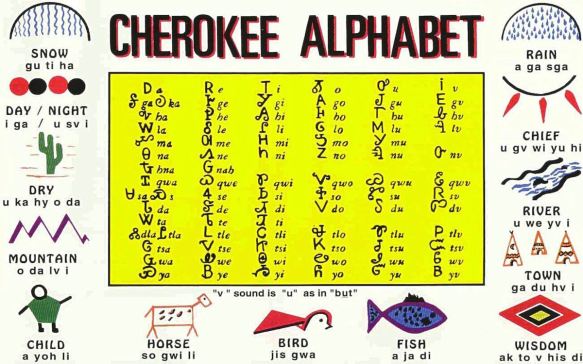
Famous Book Translated to Indigenous Languages

Cherokee_language_alphabet_Mango_Languages

Source: Google Images/Mango Languages Blog

This does my heart good – to see mainstream, classical literature help break down the barriers between the red and white worlds of this land…

From Indian Country Today:

‘CHARLOTTE’S WEB’ IN NATIVE TRANSLATION

E.B. White’s classic children’s tale Charlotte’s Web has been translated into Tsalagi and Cherokee syllabery. The translator, Myrtle Driver Johnson, is a Beloved Woman of the Eastern Band of the Cherokee who grew up on a farm in North Carolina’s Big Cove Community not unlike the farm that White owned in Maine. The book will be limited to a run of 201 copies; one will go to the White estate and the other 200 will be used by students at the New Kituwah Academy.

#indiancountry #cherokee #language #writers #charlottesweb