Copyright Tidbits

I’m a bit surprised at the lack of likes on my most recent post (A Lesson in Futility). I guess not everyone gets my sense of humor (though most of you usually do). It was meant to be a humorous look at the writing process for writers who struggle with choosing the right words (I can’t be the only one). So back to the serious writing advice, this time on copyright issues. There are some great tips provided by Joel Friedlander on The Book Designer website. Initially, I included the article here but was immediately contacted by an administrator of the site, giving me the impression I shared the article without their permission (even though I properly credited Joel and his website, and included the link to the actual article). 

Mea culpa

I still have much to learn about copyright issues, whether intentional or not. Instead, I’ve updated this post to include only the link where you can find the complete article. It’s a good read and it never hurts to be reminded of these important points. The Digital Age has certainly made copyright issues a bit more of challenge, I think, and many of us (including me) will make unintentional mistakes from time to time when sharing good information.

My apologies to Joel Friedlander and his admin and thanks for pointing out my copyright snafu!


http://www.thebookdesigner.com/2010/01/6-copyright-page-disclaimers-and-giving-credit/


Losing Your Mind on Social Media?

This morning I came across an interesting article in one of my LinkedIn Groups, Book Marketing (amidst so many others that are not – at least to me). The author, Kirsten Oliphant, writes about the overwhelm many of us experience these days with Social Media (SM) and how to choose which ones will work best for each of us. As I read the article, knots formed in my stomach. I admit I’m not tech-savvy in the world of SM and just reading about it gives me the willies. She makes a good point, though, at the beginning, about struggling with mastering SM and balancing the marketing we do there with finding time to write.

She provides three options: 1) Hire out (don’t know about you but I certainly can’t afford this option), 2) gripe and procrastinate (welcome to my world), and 3) master and manage (oh, here come the willies again). While she makes valid arguments for all three, I’m focused on the third, master and manage. If only I could learn, understand, and utilize at least a couple of SM to my advantage as a writer.

Good news: Kirsten provides a free resource guide describing many platforms in detail, so that even I, the un-savvy, can understand and utilize SM. She also provides sensible advice: choose one or two platforms you’re comfortable with and start with those. And maybe use only those, as she does advocate not going hog crazy and trying to be everywhere and everything on SM. This makes sense to me, as it allows for time to write (and work a full-time job since writing has not yet completely replaced the J-O-B lifestyle).

Still, I’ve not heard of some of the SM sites she mentions and I’m likely to stay with what’s familiar (Facebook, etc.). I’m toying with opening a Twitter account; have any of you found it to be useful for your published works? I’m just not a big fan of being “followed” by anyone, and evidently I have to follow others first for that to happen. And by nature I tend not to follow others – rather, I prefer to take my own, less-traveled road, so I don’t know if Twitter is right for me. Which means I need to read her booklet in more detail, because who knows what I may discover. Perhaps I’ll find a SM site that doesn’t overwhelm or confuse me; perhaps I’ll discover an inroad to a new marketing adventure. Regardless, I know I’ll learn something that can help me to the next step in the process, all the while not losing my mind over the there-are-too-many-options-to-choose-from menu of Social Media.

You can check out the full article here.

Subliminal Messages and The Call of the Word

maxresdefault

Source: Google Images

Stories Have a Mind of Their Own

Do you notice how your writing takes on a life of its own once a project is started? Do you wonder how you got started on it to begin with? I only recently realized that happened to me. After completing the grueling self-publishing process of my nutrition book (Agida/Agita No More), I thought about writing another  book on Chinese dietary therapy, detailing how foods can heal specific Western diseases. Then I summarily dismissed it. I was exhausted mentally and felt I did not have it left in me to start another painstaking journey down the nonfiction road. 

So Many Questions!

Everywhere I went, people asked me, “How do you treat disease X, Y, Z?” when I talked about/marketed my book. I wondered if perhaps it would make sense to write a companion book, to clarify how to eat to heal Western diseases from an Eastern perspective. Once again, I quickly dismissed the idea and bristled at the thought of going through that process again. Something nagged at me – it happens to a lot of writers, I will assume – and ideas formed in my mind about how I could actually write the book that so many seem to have hinted they needed.

Hint Hint Nudge Nudge

As I write this blog entry, I’ve already completed chapters one and two of the new nutrition book and am now working on chapter three. So much for avoiding agida. But the call from so many turned out to be a subliminal message that I finally heard (okay, so I’m a little slow on the uptake). I have found this book a bit easier to write since I’m keeping the formatting style from the first book. That means all I have to do is plug in the information, as some of the information is repeated from the first book. I love the copy/paste function! 

It was a great release to finally get the myriad rambling ideas out of my head and onto paper (though more continue to take shape since I’ve made room up there). Subliminal or not, it has occurred to me that, simply put, writers must write. Regardless of the subject, we must give in to ‘the call of the word’. 

My advice: Pay attention to the hidden messages all around you. Let them be your muse, let them inspire you to answer your ‘call of the word.’

#writer #author #publish #selfpublishing

Success and Failure: The Yang and Yin of Writing (& Life)

I’m more than a bit of a fatalist. I start each day at my computer by checking a particular set of websites: my blog (Mestengo Books), my (former) Fan pages (ROWT, 5 Element Nutrition – both defunct since Zuckerberg shut me down without explanation in 2021), and my (former) LinkedIn page. Before I do all that, I check my “fate” for the day at ifate – I leave it up to the Universe as to which type of fortune-telling card shows up (I-Ching or Tarot). Today, it was an I-Ching reading that I found relevant and is my lesson for the next twenty-four hours: Hexagram 47 (this link provides a fuller explanation).

In summary, the lesson of Hexagram 47 for today is about oppression and hope – that even during difficult or bad times we must dig down deep, not fear failure (the inevitable downswing of the life/writing-cycle), quietly embrace it, and carry on with the understanding (hope) that all will be better again (the inevitable upswing of the life/writing-cycle). Does that sound like your life or your writing? It certainly does mine. 

It got me to thinking – since I’m licensed in Chinese medicine and I see the world through the lens of Yin/Yang relationships (Universal Law of Unity of Opposites) – that oppression, defined in the hexagram as “a form of troublesome worries,” is a kind of Yin/failure that sooner or later will turn into Yang/success in the cycle of life/writing. Some days the words flow, other days they don’t. Today I struggle with finding the right words for this blog while I wrestle with a work-related decision that must be made. I can’t wait for that upswing…

I’ve also been struggling with marketing my new nutrition book (due mainly to budget constraints and lack of marketing acumen) and am looking at non-mainstream options. I know it won’t be a NY Times bestseller and I’m okay with that – it’s not what I really want anyway, because it’s not where I fit. It’s been a slow climb. Recently, however, I’ve had the good fortune to be published in Qi Journal, a wonderful publication highlighting Tai Chi, Qi Gong, Chinese medicine, martial arts and Chinese culture in general. As a result, sales of my book increased. And I’ve been invited to publish with them again (and possibly ongoing). It was a chance email I’d sent to them inquiring about writing an article because I was looking for different avenues for book marketing and ended up with the opportunity to publish a portion of my book. Talk about Yin moving into Yang!

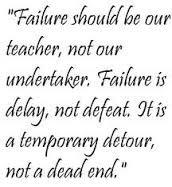
Failure  happens to everyone. It’s how you handle the failure. Ride it out, like a big bump in the road and you’ll come out the other side wiser, and perhaps, more successful. In whatever way that means for you.

failure should be our teacher

Armchair Experts and Me

More thoughts on conscious writing:

What can I say, I’m on a roll….

I’m on LinkedIn and so are a lot of other people. A LOT. Probably explains why the few groups I joined  seem to be brimming with what I call “armchair experts” (any more than that seems a waste of time and TMI for me). Don’t misunderstand, some (perhaps many, I haven’t taken a poll) are successful with their work. But many (or perhaps some, I still haven’t taken a poll) are not – but think they should be, based on their expertise. (And why haven’t I heard of these experts?)

One of the groups  – Book Marketing – sends me a weekly digest of (too many) topics being discussed. I’m amazed (and often overwhelmed) by the varying opinions (remember, we’re all experts on our opinions) on how to market one’s work, publish to the masses, find that secret to getting the world to recognize our work, etc. Sometimes the advice seems ridiculous, sometimes it helps. Mostly you have to “read and weed” through the junk to find the proverbial needle in the haystack that will help advance your writing/work. 

One of my top pet peeves is (and has always been) people who talk like they know when they don’t. I refer to them as “armchair experts (AE).” Here in the U.S., the number of AEs appears to have grown exponentially with the advent of social media sites. Or is it my overactive imagination, mixed with a pinch of cynicism and a dash of arrogance? With so many of these AEs online, it seems they have solutions to my problems – both personal and professional. In my (expert) opinion, there is a lot of preaching about what one “should do” but how many are asking “Do you want my advice?” in the first place?  I’m reminded of a poem of sorts I have stashed away somewhere in storage, on the definition of a friend, and this is one piece from it: a true friend is someone who does not give advice without your request.

That’s called preaching.

One definition of preaching (as a verb and in secular text) is “to do this in an obtrusive or tedious way.” So i looked up obtrusive (an adjective, for context): “having or showing a disposition to obtrude, as by imposing oneself or one’s opinions on others.” (I added all the italics.) How many people start their sentences (verbal or written) with some form of “you should…”? The moment I hear that sentence, the tone in the voice, and watch the body language, I think – uh, oh, here it comes. The preach. The “I-know-just-what-you-need-though-you-didn’t-ask-me” monologue. No faster way to get me to leave the table, the room, or the website/blog. If you haven’t taken the time to ask (then truly listen), then you don’t know what I need (or want). You can’t assume I want to hear what you have to say, no matter how wise or beneficial your words may be. Let me first ask.

It’s rather like a famous diet (yes, more conscious eating metaphors) – The Paleo Diet, The Virgin Diet, The South Beach Diet, and on, and on… As with these famous “diets,” some of us will succeed in following the diet, others will not. And some will find the courage to take our own roads with our writing and learn the accompanying lessons, since it’s about the journey, not the destination, after all.

Any thoughts? (Yes, I’m asking…hee hee)

Conscious Writing as Important as Conscious Eating

the writing process2small

Conscious Writing – the must-have recipe for success

On the (now defunct, thanks to Meta Zuckerberg) Fan page for my nutrition book, I posted a blog on conscious eating. In writing that blog, an idea formed in my mind that we, as writers, must also write consciously. Not that we’re sleeping while we write, mind you; it’s more about being present, relevant, and aware of our work in quality and quantity. We’re all so busy racing to Twitter, to post to Pinterest, Google+ and too many other online venues to get our work noticed that we each lose something along the way. Much of our vocabulary has changed to a texting-style spelling (you, too is now u2, and so on) to save time and in the process, some have lost the ability to express thoughts and ideas clearly. Hence the concept of ‘conscious writing.’

A food recipe lists the ingredients, the quantity of each ingredient, and how many people it will serve. Conscious writing is no different. Your main topic is the recipe and each point you make to support your topic is one of the ingredients. Once all the points are covered, you have a recipe for a complete article/book/blog. As for how many people it will serve, that will depend on your ability to market your writing – be it a blog, a book, etc. Also, the quality of the recipe/story needs to be relevant and interesting. Don’t forget about good grammar and spelling (as they too, have all but disappeared from many a blog/article) – use spell check and thesaurus religiously to weed out homonyms and incomplete or run-on sentences. (In other words, get out of the habit of writing as you speak.)

In a recent blog on Puttylike, a website for self-described “multipotentialites,” I read an article (several times already today) titled, “I saw it as the one defining principle of my life that kept me from achieving greatness.” It’s a must-read for anyone out there who’s not sure where they fit in the bigger scheme of things, especially in the world of writing.

That being said, I’d like to add my opinion (remember, I’m an expert on it) that the more varied a life we live, the more interesting our writing will be, since we have a wider range of subject matter from which to choose. Unlike all those so-called experts who spend their adult lives specializing in only ONE area of interest and are unable to see how their expertise is connected to many other areas, our recipes/stories are both unique and relevant.

And hopefully conscious.

Conscious Marketing

And it dawned on me that marketing, advertising and PR are a part of that recipe, the conscious writing process. How can I give my work to the world if I don’t know how to package it? What are the ingredients (a dash of marketing, a sprinkle of advertising, and two tablespoons of PR) that make up a good dish/story? It’s different for each of us. Every now and then, someone shares a few unique approaches/recipes for success. In her blog, Build Book Buzz, Sandra Beckwith shares with her readers a wonderful little success story about how one woman came up with some different ways to sell herself and her book. You can read about her unique approaches here.

I met with a friend on Tuesday to brainstorm and he told me about a friend of his who wanted to get her book into Barnes and Noble. So what did she do? Did she take the traditional route of hawking her wares to the book buyers? Not even close. She simply walked into a local B&N store and left a copy of her book on a shelf. Then, when someone went to buy the book, they couldn’t because it wasn’t in the system. The clerk had to add the book to the system and they had to buy copies, since there was a demand.

Talk about conscious marketing!

#amwriting #authorsoninstagram #writersoninstagram #poetry #grammar #spelling
The Write Stuff

I am a writer

Feeling Like a Needle in a Haystack

With the explosion of freelancing sites like Fiverr, Freelancer, ODesk and too many others to name here, writing for other people has become prolific, a phenomenon even. I (and I’m sure you, too) struggle to stand out among the gazillion freelance writers now available at our fingertips.

The quality of said writing, however, has reduced drastically in the rush for people around the globe to become qualified, paid writers with access to the world. You can check a multitude of websites and you will find more grammatical errors  than you can shake a stick at, including articles on the venerated Associated Press site. Not to mention the poor English skills (reading, writing, and speaking), an issue not uncommon right here in the U.S.

Express Yourself!

My biggest pet peeve in this writing explosion is overuse of the word “thing.” In one AP article I read some years ago, I counted sixty-four uses of the word in ONE article. That’s discouraging, since AP is reputed to have excellent, intelligent journalists on staff. In a Constitutional Law class I took for my Criminal Justice program, our professor (then Democratic Speaker of the House or something like that) basically outlawed the use of this ubiquitous noun. He told us it represented an inability to properly express ourselves. I opt to restructure my sentences with stronger noun-verb connections to better illuminate my messages.

So I ask again, how do I (you) make my (your) work stand out? For one, by sticking to my (your) principles. I refuse to dumb myself down to appease the masses. My fiction novel, Rescue on White Thunder (not available publicly at this time), was once referred to as parochial (by a friend, if you can believe it). My immediate response to her was that since the literacy level in the U.S. is at the 6th grade level, my book had a wider target market. (snicker snicker)

Too Much of a Good Thing?

I’m bombarded by LinkedIn discussions (via emails from my former LinkedIn account) by many so-called experts in book marketing/sales. Yet I’ve not heard of any of these people (not that I know many to begin with), and I certainly have not heard of any of their books.

Everyone’s an expert these days (more like a marketing tool than an actual accomplishment, I believe). A professor in medical school (a different degree program) once jokingly told our class that he’s an expert – but only in his opinion. It was then I realized ALL experts are just that – someone who is accomplished in his/her field and publicly shares their interpretation of the information.  And that’s it in a nutshell.

It’s All in How You Look At It…

You can pick any field, anywhere on the planet, and you won’t find a hoard of experts who will all agree to the same information. It’s all in the interpretation of the data. Which takes me back to my original issue of being recognized for my work. At this point, all I can do is continue to write and publish my books and stick to my principles. That gets my name out there in various circles, since each book (so far) has been in a different genre.

That’s the write stuff for me.

#writersontwitter #writersoninstagram #authorsoninstagram #amwriting #writersworld


Welcome to Mestengo Books

wp-1611032154620.jpg

Welcome to Mestengo Books, a gathering place for my works of fiction and nonfiction. I wracked my brain for hours to come up with a good name to represent me and my books. With so many blogs/sites already out there, it’s difficult to come up with something original. The horse, for some reason, has been a totem animal in my life for, well, all of my life – since childhood.

Mustangs are my favorite horse. They’re a hardy breed, borne of Spanish bloodlines, and have survived the wilds of the Americas for centuries. The name mustang itself, a popular one and already taken for many blogs/sites, has a neat history. It comes originally from an old Spanish word mestengo (16th century, according to Wikipedia) that translates to wild, stray, ownerless. I knew the moment I saw the meaning I’d found the title I’d searched for all day. And anyone who knows me well enough can certainly attest to the fact that I am, without a doubt, una mestenga.

Remember: I write. You read. It’s that simple.